
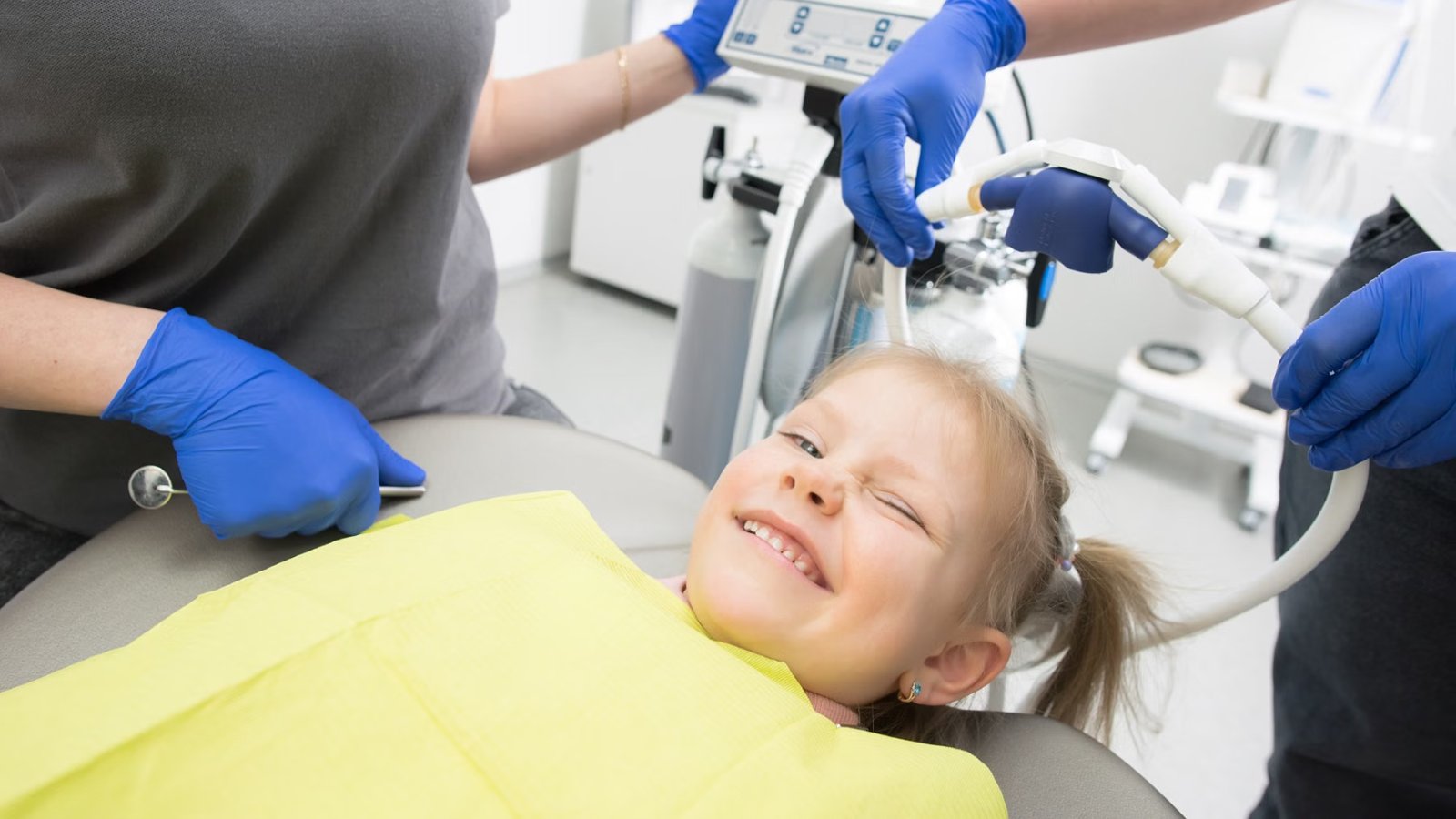
Baby teeth are not “just temporary”: they hold space for the permanent teeth, help with chewing and learning to speak, and a decayed baby tooth can hurt and become infected. In this article we explain how we treat children’s teeth so that a visit to the dentist doesn’t become a bad experience.
When should the first visit be?
We recommend the first visit once the first tooth has come through, and by the first birthday at the latest. At this stage we don’t treat anything: we look at the teeth, show parents how to brush properly and let the child get to know the practice. Children who come for regular check-ups are less likely to end up in the chair with toothache.
Prevention is the gentlest treatment
- Fluoride toothpaste (at least 1000 ppm fluoride) twice a day from the first tooth: a smear the size of a grain of rice up to age 2, a pea-sized amount from 2 to 6. Brushing at bedtime matters most. Spit out the toothpaste but don’t rinse with water. Until about age 7–8, a parent should help or brush after the child.
- Fluoride varnish – a protective layer painted onto the teeth that strengthens the enamel. Painless and takes a few minutes; for children at higher risk of decay we usually repeat it several times a year.
- Fissure sealants – we seal the deep grooves of the permanent back teeth with a thin resin coating, so plaque and bacteria are much less likely to get trapped there. We check the sealants at each check-up.
- Fewer sugary drinks – sipping sweet drinks all day or drinking from a bottle at night does the most damage. At night, after brushing, only water.
AgF – stopping decay without drilling
In silver fluoride (AgF) treatment, we paint a liquid onto the decay with a small brush. The silver kills bacteria and the fluoride hardens the tooth, so in many cases the decay stops – with no drilling, no injection and no pain, in a few minutes. This makes it a very good option for young children who can’t yet manage longer treatment.
At our practice we use a modern water-based, ammonia-free product, so it doesn’t burn the gums or the lining of the mouth, and it tastes better. Potassium iodide, applied in a second step, significantly reduces the black staining typical of older products, so the treated tooth changes colour much less. If the treated area does darken over time, the tooth can be covered with a tooth-coloured filling. To keep it working, the treatment is usually repeated every six months. It is not suitable for a tooth that is already very painful or infected, and we don’t use it if there is a silver allergy.
Oral sedation with midazolam
For anxious children having shorter treatments, an oral sedative called midazolam can help. The child drinks it about 20–30 minutes before treatment. The effect usually lasts roughly 30–45 minutes, so it suits shorter treatments: the child stays awake but is calm and drowsy, and often doesn’t remember the treatment. It doesn’t work equally well for every child, and occasionally a child becomes restless instead of calm. Throughout the treatment we continuously monitor breathing and pulse, including with a pulse oximeter (a small finger clip).
- The child must be accompanied by an adult they know well and stay under supervision for the rest of the day – no nursery or school that day. If the accompanying adult is driving, a second adult should come along to watch the child in the car.
- We will give you clear instructions beforehand about eating, drinking and any medicines.
- It isn’t suitable for every child – for example under one year of age, with sleep apnoea or heavy snoring, or certain heart, lung, muscle or liver conditions. If your child is unwell on the day (a cold or fever), we will rearrange the appointment. We decide all this at a consultation.
Treatment under general anaesthetic
If a child needs several teeth treated, is very frightened or has special needs, we can carry out treatment under general anaesthetic – directly at our practice. The anaesthetic is given by an anaesthetist, who watches over the child throughout. We can usually complete all the necessary treatment in one visit; the child is asleep and feels nothing during the treatment.
- Beforehand your child needs a check-up with their paediatrician, and the anaesthetist will also assess your child before the procedure.
- We give you written instructions in advance on when your child must stop eating and drinking – it is important to follow them exactly.
- After waking up, your child stays with us for a while for observation and then rests at home for the rest of the day. Tiredness, a sore throat, mild nausea or sore gums are common afterwards and pass quickly.
New, gentle techniques we use
- The Hall technique – a preformed metal crown is fitted over a decayed baby molar, with no drilling and no anaesthetic. The crown seals the decay in, which slows or stops it. It is only suitable if the decay has not reached the nerve, so we check with an X-ray first; sometimes small rubber spacers are placed between the teeth a few days before. Studies report success in around 86–88% of treated teeth after two years.
- Antibiotic paste instead of root canal treatment in baby teeth (3Mix-MP, the LSTR method) – if the nerve of a baby molar is inflamed or has died, instead of conventional root canal treatment we place 3Mix-MP, an antibiotic paste prepared for us by a pharmacy to a specific prescription, inside the tooth and seal it. The treatment is shorter and gentler because the thin, curved canals of baby teeth don’t have to be fully cleaned, and the tooth can often be kept until the permanent tooth comes through. We use it mainly in baby teeth, and it needs regular X-ray check-ups.
- Bioactive filling material (ACTIVA Kids) – a filling material designed for children’s teeth which, according to the manufacturer, releases and takes up calcium, phosphate and fluoride, helping to harden the tooth at the edge of the filling. It contains no bisphenol A (BPA), is less sensitive to moisture – a big advantage with wriggly little patients – and also covers the dark spot left after AgF treatment.
- Micro-invasive treatment – early decay that has not yet formed a hole can often be stopped without drilling: with fluoride, sealing or ICON resin infiltration. ICON can often make white spots on the enamel much less visible; how well it works depends on the type and depth of the spot.
- Digital X-rays – the image is ready immediately and usually needs a lower radiation dose.
- Entonox (gas and air) – helps older, cooperative children feel less anxious. It provides only mild pain relief, so we still numb the tooth if needed.
Which option is best always depends on the child’s age, the condition of the tooth and how well the child can cooperate. We go through this together after the examination.
When to contact us straight away
If your child has toothache, a swollen cheek or gum, or has chipped or loosened a tooth in a fall, call us as soon as possible on +421 919 189 988. Go straight to the emergency department or call 155 if a swelling is spreading quickly, your child has a fever, has difficulty swallowing or breathing, or if after a fall your child lost consciousness, is vomiting or seems confused.
If a permanent tooth has been knocked out: hold it by the crown (the white part), not the root. If it is dirty, rinse it briefly in milk or saline – don’t scrub it. If you can, gently push it back into its socket and have your child bite on a clean cloth. If that isn’t possible, put it in milk (or in a little of your child’s saliva in a cup). Never let it dry out and don’t keep it in water. Come to us immediately – every minute counts. We do not put knocked-out baby teeth back, but please still bring your child for a check-up.